

On 17th September, Candyspace and Optimizely brought together senior leaders from across enterprise B2B in London to discuss one of the biggest questions facing digital teams today: where should investment and attention be focused?
The conversation spanned content strategy, internal governance, AI adoption and organisational change, as well as the challenge of creating simpler customer journeys across complex organisations. One finding stood out: 80% of attendees polled said internal approvals and governance were the biggest blockers to moving faster.
Across the discussion, four themes kept coming up: simplifying the technology landscape, removing friction from customer journeys, improving internal processes and governance, and finding ways to get value from AI. Here we explore these themes in more detail and the implications for where enterprise B2B organisations focus their digital investment.
Consolidating tech stacks and making smarter investment decisions
Several stakeholders in the room highlighted the challenge of fragmented technology stacks across their organisations. They referenced using too many tools that did similar things, which meant ROI was also difficult to measure.
This reflects a wider challenge for enterprise organisations. As digital teams have grown, so has the number of platforms and technologies supporting them. Different teams often adopt different solutions to solve specific problems, creating a landscape that can be difficult to manage and even harder to rationalise.
Instead, digital executives need to make technology investment decisions based on evidence. This means looking beyond the initial cost of a platform to understand the total value it delivers.
ROI doesn't necessarily mean being able to attribute a direct revenue figure to every technology investment. It means creating a clear link between the cost of a platform and the business outcome it enables – whether that's increased conversion, reduced operational costs, faster delivery, better customer experiences or reduced technology risk.
For example, if several platforms perform similar functions, management should be able to understand the total cost of ownership, how heavily each platform is being used, the cost of maintaining integrations and the business value each one delivers. This creates a much stronger basis for deciding whether to consolidate, invest further or simply make better use of what already exists.
The goal shouldn't be to have the most sophisticated technology stack. It should be to have a technology ecosystem that is simple enough to manage, flexible enough to evolve and effective enough to deliver measurable value.
Removing friction from complex customer journeys
Another central topic of conversation was around friction within customer journeys. We began with a live poll which revealed that for over 50% of attendees, understanding whether the customer journey fits their needs was the greatest challenge.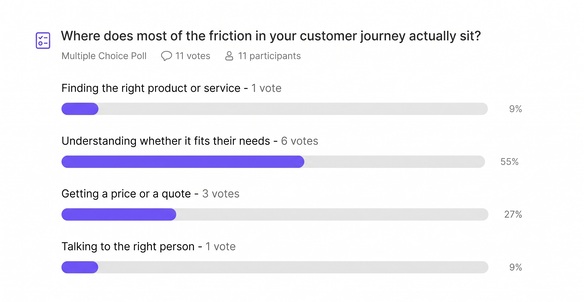 The B2B customer journey of today certainly doesn’t follow a straight line. It involves complex, multi-stakeholder buying decisions, long sales cycles and a mixture of digital and offline touchpoints.
With so many different channels, it can be difficult to understand where friction is actually occurring. While there is no one-size-fits-all approach, there are some key areas leaders should be considering when looking to optimise their customer journeys.
Start with the data
The first step is getting a clear picture of what is happening. Are your data sources accurate and connected? Can you identify where customers are dropping off, what they’re searching for and where they move between channels?
Good data can help teams find the gaps in the journey and challenge assumptions about what customers actually need. AI can also help teams analyse large volumes of data, identify patterns and surface opportunities more quickly.
Make personalisation meaningful
Understanding your audiences is more important than ever. Yet personalisation doesn't have to mean creating a completely different journey for every individual. It can be as simple as making content, messaging and pathways more relevant to different audiences and where they are in the buying journey.
Leaders should also consider whether their existing platforms have the capabilities to support this, before assuming further investment is needed. For example, Optimizely Personalization can use behavioural data to adapt messaging, imagery and content based on a visitor's behaviour or journey stage, while audience segments and data from multiple sources can help teams deliver more relevant experiences.
Build a culture of experimentation
Even with good data and audience insight, organisations can't always predict what will work. A/B testing allows teams to test changes to messaging, content, navigation or calls to action and use evidence to understand what actually improves the experience.
Reducing friction ultimately involves creating a continuous cycle of using data to identify problems, test improvements and learn from the results.
Improving internal processes and governance
We also asked attendees what the real barrier to moving faster was within their organisations. 80% selected internal approvals and governance as the biggest obstacle, with the remaining 20% voting for people and skills. 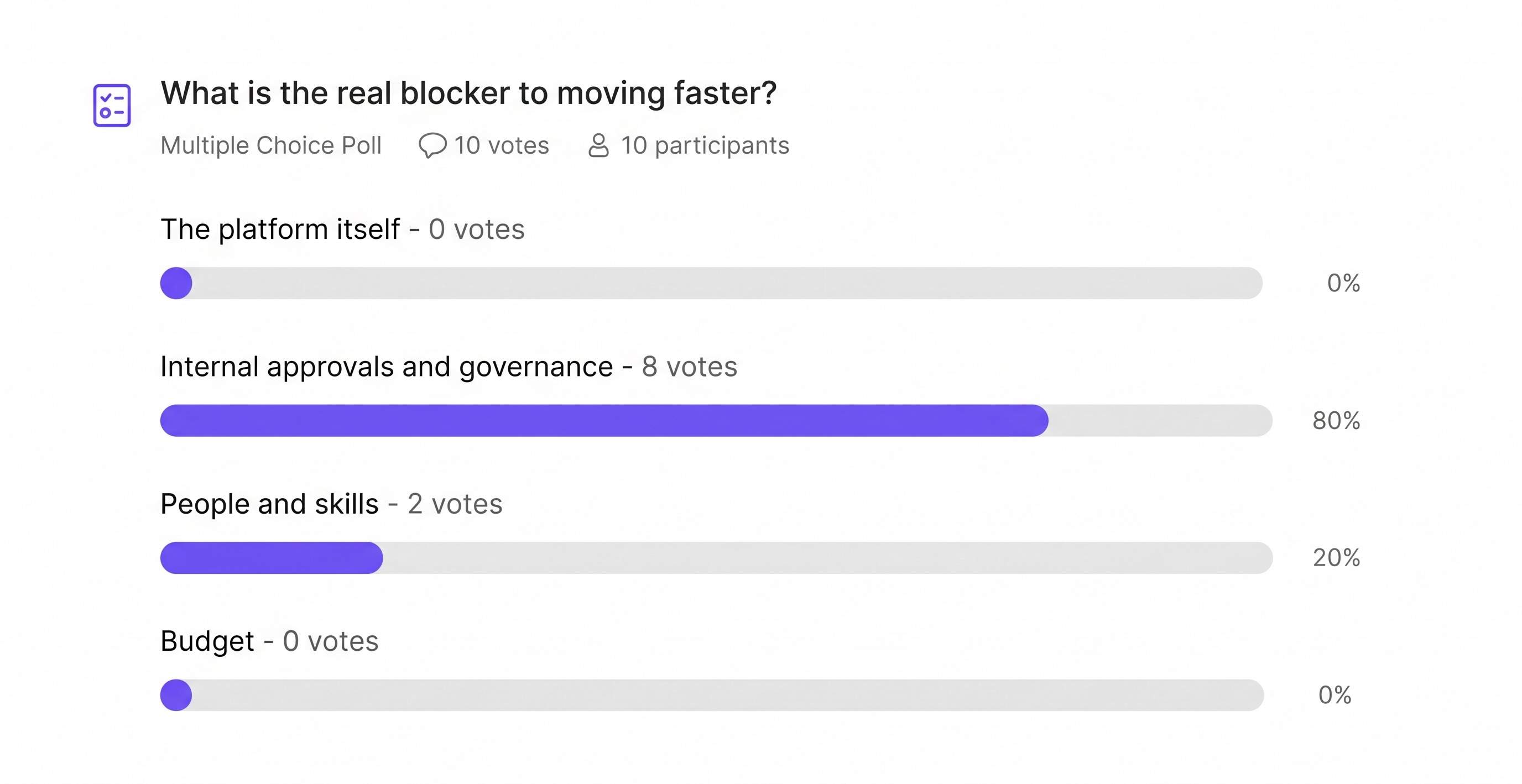 This highlights that the barriers to digital progress aren't always about technology, ideas or budget. In complex organisations, layers of approval, unclear ownership and siloed teams can make it difficult to move quickly and turn good ideas into action.
We also heard from one stakeholder whose teams weren't getting the most out of a large enterprise system because of the complexity and training involved. This reinforces the importance of looking beyond what technology can do on paper and considering whether teams have the skills, time and support to actually use it effectively.
Aligning teams is also key to improving the customer experience. When teams work in isolation, customers can end up experiencing disconnected journeys, inconsistent messaging or duplicated processes. Better communication, clearer ownership and shared goals can help teams work towards the same customer outcomes rather than optimising individual parts of the journey.
Getting more value from AI
AI was, unsurprisingly, a major theme throughout the discussion. Decision-makers were thinking about how to make it genuinely useful - both for their people and their customers.
Leveraging AI tools can help extend employee capabilities, reduce repetitive tasks, and free up time for higher-value work. Automating routine processes or accelerating tasks such as research, content creation and data analysis can give teams more capacity to focus on strategic thinking and work that may otherwise be difficult to resource. However, this requires training and clear guidance so teams understand where AI can add value and where human judgement remains essential.
Several attendees also highlighted that different teams within their organisations were using AI in varying ways. In large, complex firms, this can create duplication, inconsistent approaches and teams working in isolation. Better communication and knowledge sharing across these silos will be important to build greater coherence, share what is working and establish common principles for using AI.
AI is changing how customers find information too. B2B organisations increasingly need to think beyond traditional SEO, considering AEO alongside their existing paid search strategies as customer search experiences become more AI-driven.
This shift in how customers engage with information is only one part of the change. For enterprise organisations, AI is also reshaping how teams access knowledge, work with data and make decisions – with the potential to improve how the organisation operates from the inside out.
At Candyspace, we see the next step as moving beyond using AI to automate individual tasks towards building enterprise intelligence. This means connecting AI to the data, knowledge and workflows that already exist across the organisation so people can make better decisions and act on them faster. It requires more than adding another AI tool to the technology stack. It means creating the right foundations, governance and human oversight to make intelligence accessible across the business, while turning proprietary data and knowledge into an asset that grows in value over time.
The result is AI that is embedded into how organisations work – creating new capacity, improving decision-making and delivering measurable business impact.
AI Workshop: Design an AI agent around your business needs
On Thursday 26 November, we’re hosting a hands-on AI workshop with Optimizely. Discover real-world applications and explore how agents could address challenges in your business.
Register your place here.
What should enterprise B2B leaders focus on now?
The conversation highlighted that the answer isn’t simply to invest more in digital. For enterprise B2B organisations, the real challenge is creating the conditions for digital investment to deliver value – for customers, teams and processes across the wider business.
That means tackling the complexity that gets in the way. Simplifying technology where it has become fragmented, removing friction from customer journeys, making it easier for teams to work together and using AI where it can genuinely improve how the organisation operates. It also means being prepared to challenge existing ways of working rather than simply adding another platform, process or AI tool to the mix.
At Candyspace, we believe digital works best when customer needs and business objectives are brought together. Technology is an enabler of that, not the destination. The organisations that are best placed to adapt will be those that build the flexibility to respond to changing customer expectations, make better use of their data and technology, and continuously improve the experience they deliver. The focus should be on making digital work harder for the business and its customers.
If you’re reviewing your digital strategy, simplifying your technology estate or exploring how AI can create measurable value, we’re here to help.
Get in touch to identify where digital investment can make the greatest difference.
You can also watch our highlights reel from the event to hear directly from attendees and revisit the key insights from the day.